

Closing Time. (I know you are all singing along right now!)
Open all the doors and let you out into the world.
I would love to praise the songwriting genius of Semisonic right now but I’d like to tackle a more relevant topic.
It’s the importance of having a shutdown ritual. This term was popularized by productivity expert Cal Newport in his book Deep Work.
If you are anything like past me, you might leave your desk in a crumple of a mess at the end of the day, rush out the door, and struggle to switch off once you get home and remember sixteen things you can’t forget before tomorrow morning.
It’s your lack of a shutdown ritual that’s the problem.
A shutdown ritual allows you to:
- disengage from the work day
- move from your professional responsibilities to your personal life
- close open loops
- help decompress as you end your day
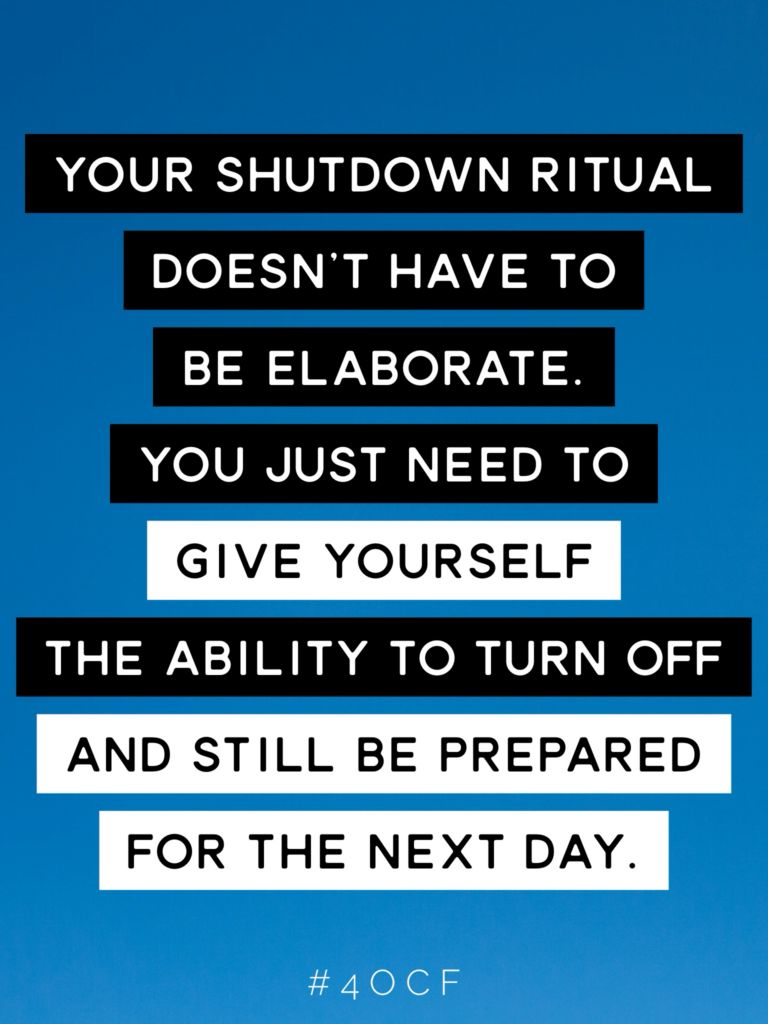
Your shutdown ritual doesn’t have to be elaborate. You just need to give yourself the ability to turn off and still be prepared for the next day.
Consider these strategies as you build your shutdown ritual:
Brain dump. At the end of your day, take out a notebook and write down everything that’s on your mind. It can be a list of everything you need to finish tomorrow. Ideas for an upcoming staff meeting. Upcoming calendar events. Whatever you need to get out of your head and record either analog or digitally. The key is to close all of the loops before you head home for the day.
Tidy time. You might want to clean your physical space before you go. Just like making your bed in the morning feels good and sets you up for success throughout your day, tidying up your space at the end of the day sets you up for success tomorrow. You want to come into a neat and organized space the next day where you don’t have to start by cleaning. Spend a few minutes organizing and leaving your space positive-start ready. You’ll be glad you did in the morning.
Big three. After you’ve done your brain dump and gotten everything down on paper, choose your big three items that need to be completed for the next day. Walking in the next day with your highest priorities already outlined and ready to go prepares you to be productive. It also allows you to be less anxious at night thinking about what you need to do tomorrow.
Sweep the inbox. Take a quick five minute glance over your inbox. Delete any spam or irrelevant messages. Flag anything that needs to be addressed tomorrow, and quickly answer anything absolutely immediately urgent. The inbox sweep allows you to completely turn off for the night, and not have to worry about what’s waiting in your inbox the next day. Pro Tip: Take your email inbox off of your phone or at the very least, turn off notifications. There’s usually nothing so critical that it can’t be addressed in the morning.
Closing Cue. This is critical to a good shutdown ritual. Find something that’s going to create an actual transition from your professional duties to your personal responsibilities. Cal Newport repeats a phrase “schedule shutdown, complete.” I write down everything in my notebook, close it, place it in a drawer, and close the drawer. This allows me to know that my day is done. Once the notebook is closed and the drawer is shut, I’m on my way home. A little music in the car helps me transition to family mode. Build a closing cue into your routine to establish closure within your day.
The goal is not to create an additional thirty minute routine that keeps you at work any longer. The goal is to build a quick bridge between your work self and your home self. When you close loops, tidy up, and set your goals for the following day, you give yourself permission to actually rest. Try out a few of these strategies this week and see how lighter you feel walking out the door at the end of the day.
After all every new beginning comes from some other beginning’s end.
Rich
For more productivity strategies, pick up a copy of Autopilot: Practical Productivity for School Leaders.